LIVING ATLAS

THE PUBLIC PRINTING OFFICE

ISSUE 001
CURRENT PUBLIC EDITION
PRICE · ONE USEFUL FACTCURRENT PUBLIC EDITION

THE GRISTLEWICK RECORDER

ISSUE 001GRISTLEWICK STATION DISTRICTCANON DESK · PUBLIC COPY

THE PUBLIC RECORD

SUNSPINDLE HOLDS THE HEAT. GRISTLEWICK GETS THE COLD.

One cracked heat brick has stopped a consignment at Railgate. At Gristlewick Station, warmth is still listed as expected.

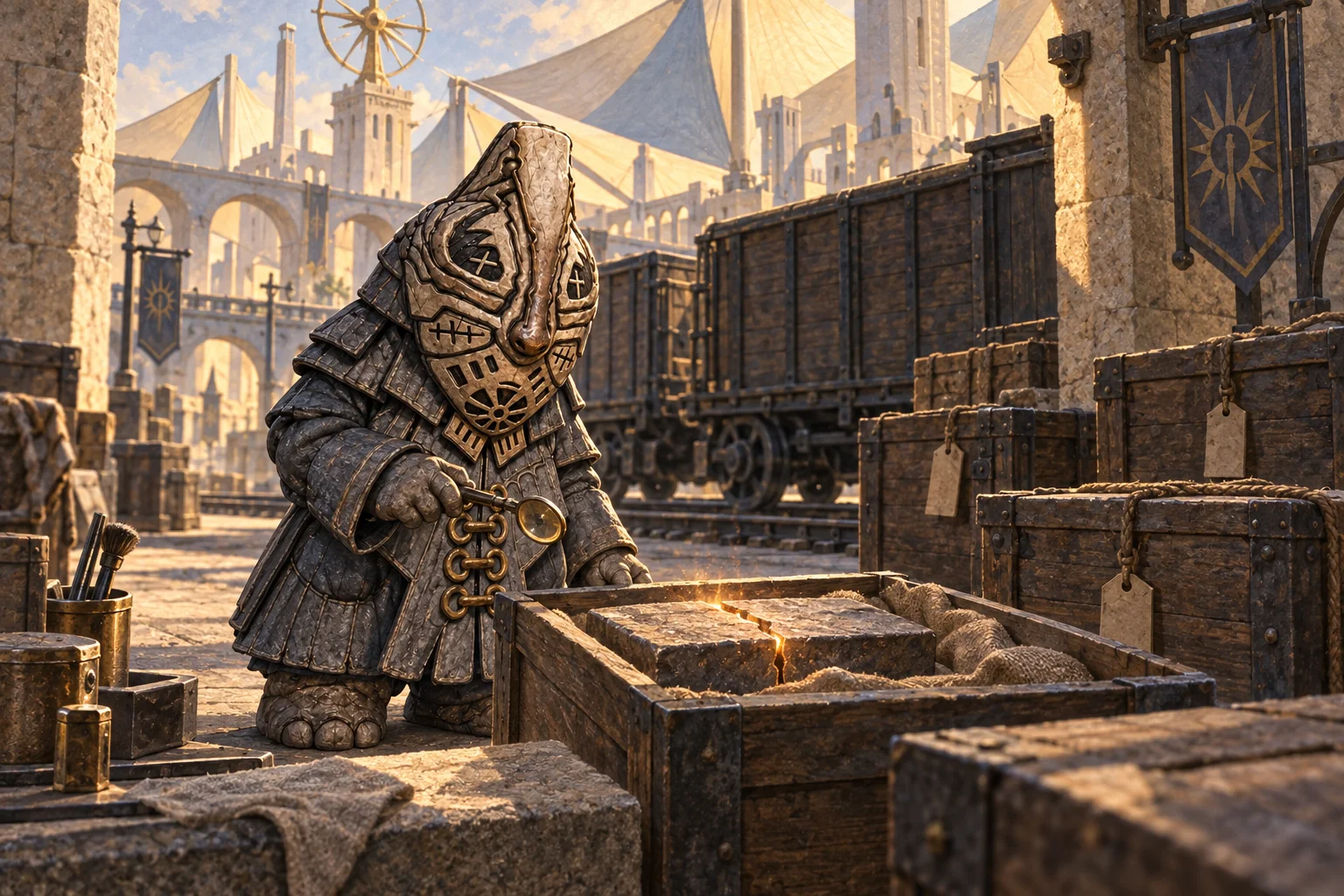
A shipment of Sunspindle heat bricks intended for Gristlewick Station has been held at Railgate after Bram Sivet found a fault in one of the packed bricks. The outer surface was cooling. Heat continued to escape through a crack beneath it.

The distinction matters to anyone planning to stack the consignment, travel beside it or put a hand where the warmth appears to have gone.

Bram requested that the remaining bricks be separated and checked before loading. A dispatch entry showing that the shipment had been prepared was offered in response. Bram inspected the brick again.

“The entry is in order,” they said. “The brick is not.”

No departure time has been confirmed. The inspection is intended to establish whether the fault belongs to a single brick or the batch. It has not yet established why the crack formed, and there is no evidence of deliberate damage.

In Gristlewick, the missing consignment has interrupted preparations to warm a waiting area before the evening arrivals. Passengers can still wait there. Whether they can do so comfortably is a separate question, one the timetable does not address.

The effect reaches beyond the cold seats. Space reserved for the arriving freight remains tied up while the station seeks a reliable arrival time. Other goods are being held clear of the expected delivery. At each end of the journey, somebody is waiting for an answer from the other.

There is pressure to release the sound-looking bricks and examine the rest later. A crack hidden beneath a brick is not much inconvenienced by looking sound from above. Bram has continued the inspection.

Nobody has been reported injured. That should not make the delay easier to dismiss. A safety check that prevents an accident leaves very little to photograph apart from work and people impatient for it to finish.

By late afternoon, the crates were still at Railgate. Gristlewick had received an explanation but no heat. Those already waiting at the station might reasonably prefer both.

The Recorder is seeking the inspection result and a revised delivery time. Until then, passengers should bring an extra layer. The consignment’s expected arrival is not a source of warmth.

FOLLOW THIS INCIDENT →Railgate →
SUNSPINDLE HOLDS THE HEAT. GRISTLEWICK GETS THE COLD., approved public visual record
EDITORIAL ILLUSTRATIONFILED · APPROVED · SLIGHTLY INCONVENIENT

MORE FROM THE CURRENT EDITION

The other matters the district failed to keep quiet.

Canopy Market

Editorial illustration for THE CRATES SAY HERBS. THE RUMOURS SAY MURRIK.

THE CRATES SAY HERBS. THE RUMOURS SAY MURRIK.

Whispers of restricted stock travelling to Gristlewick have reached the station ahead of any evidence. At Canopy Market, one name keeps coming up—and nobody will say who mentioned it first.

Something is leaving Canopy Market in tightly bound crates. According to the paperwork, it is herbs. According to the conversation beneath the canopies, the paperwork has led a sheltered life.

Murrik, the market’s grower-broker of restricted herbs and powerful spices, is being named in rumours of a concealed trade feeding into Gristlewick Station. The allegation is that prohibited stock travels inside otherwise ordinary consignments, with the useful part of the transaction taking place somewhere between dispatch and inspection.

The Recorder has not established that this is happening. Nor has it established that Murrik packed, owned or arranged the carriage of any suspect crate. Three people repeating a name do not necessarily constitute three sources. They may constitute one conversation that has gone for a walk.

At the market, an account of a late collection has acquired several incompatible details. In one version the crate smelled sharply of pepper. In another it had no smell at all, which was considered more suspicious. Nobody offering either version would identify the carrier.

Murrik was found attending to his stock beneath the hanging growth, letting a prospective buyer wait while he finished weighing a bundle. Asked about the Gristlewick rumours, he offered no account of a shipment.

“If you have a question about a parcel,” he said, “bring the parcel.”

It was not a confession. It was not especially helpful. Both facts can be printed together.

At Gristlewick, the uncertainty is already affecting legitimate deliveries. Buyers have begun asking for additional assurances about market consignments; carriers want to know which assurances would satisfy them. A cook waiting for lawful spice stock has considerably less interest in the mystery than in the whereabouts of supper.

That is the difficulty with a rumour carried through a working station. It does not need to be proved before it starts delaying somebody else’s goods.

The unanswered question is narrower than the gossip: has restricted stock reached Gristlewick undeclared, and if so, through whose hands? Until a consignment, a record or a witness connects Murrik to it, his name remains attached to an allegation—not a finding.

The Recorder will follow the freight. Anyone forwarding another version of the story is asked to include where it came from.

FOLLOW THE EVIDENCE →

Gristlewick Central Station

Editorial illustration for Wrong desk produces correct directions; official desk requests explanation

Wrong desk produces correct directions; official desk requests explanation

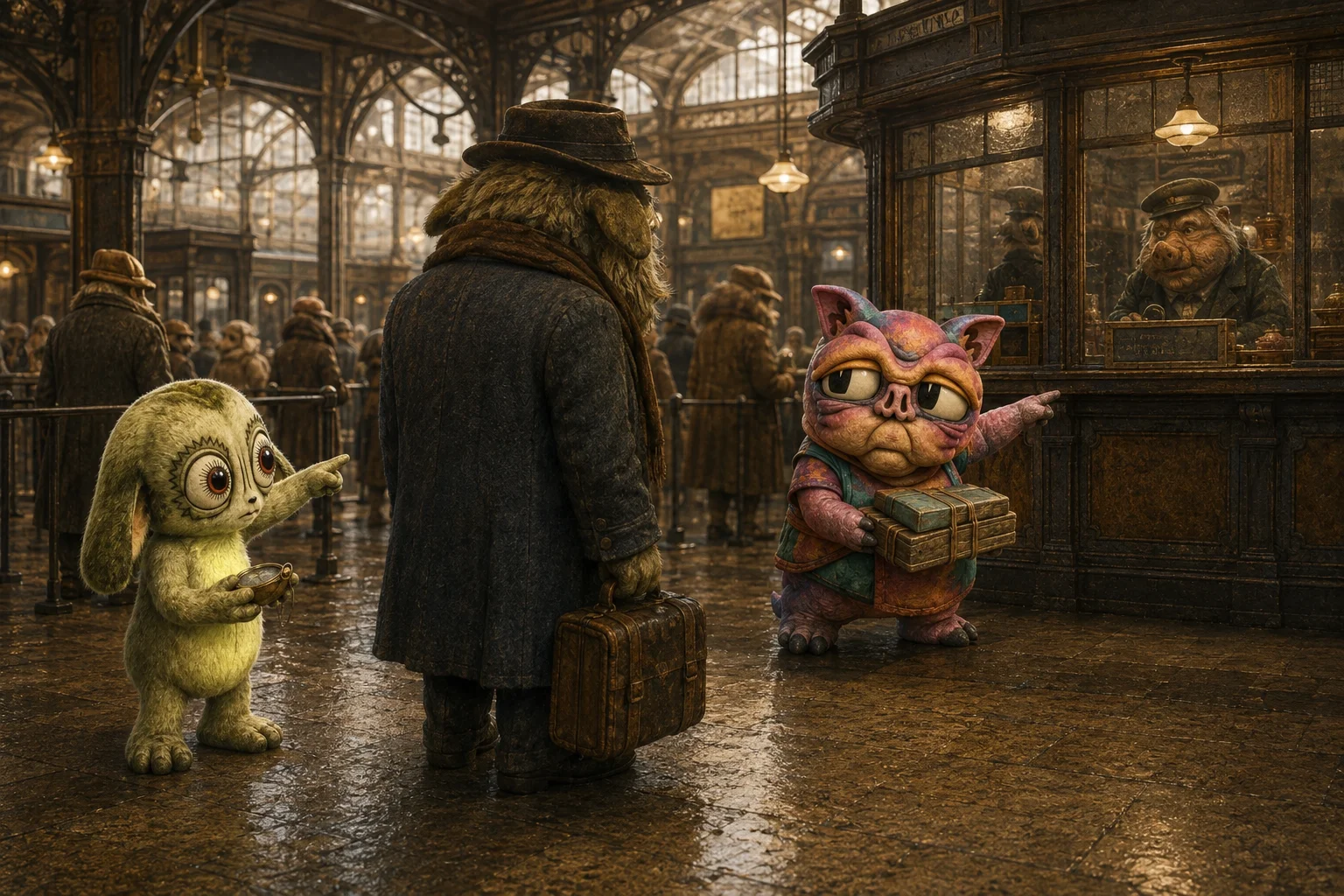
Luma noticed the problem, Brindle knew the useful route and one traveller arrived without giving the station a fair chance to become confusing.

A traveller who approached the wrong desk at Gristlewick Central Station nevertheless reached the correct counter through an informal chain of resident assistance. No authorised route was followed. No official instruction was contradicted. The traveller simply arrived, leaving the station to determine whether this counts as success.

Luma noticed the confusion and passed the practical problem to Brindle, whose knowledge of regular vendors, counters and the paths between them proved more useful than the traveller’s original choice of queue. The handoff had no desk, budget, title or sign. It possessed only the awkward advantage of working.

The incident does not show that official directions are wrong. It shows something less comfortable: a direction may be correct while still requiring somebody nearby to notice which person cannot use it. That work is small, difficult to count and already being done.

An inquiry into the irregular success would be understandable. The Recorder recommends beginning by asking Luma and Brindle what happened, before installing a sign explaining why it should not happen again.

FOLLOW THE EVIDENCE →

Gristlewick Station Yard

Editorial illustration for Yard movement completed after silence performs unauthorised public service

Yard movement completed after silence performs unauthorised public service

Drelm supplied the force, Nubble held the threshold and an unlicensed pause did what several instructions had failed to do.

A stalled movement in Gristlewick Station Yard was completed after the crossing fell unusually still and two resident workers acted in sequence. Nothing spectacular happened, which is why everyone involved remained available to be interviewed afterwards.

Nubble recognised that ordinary movement had become unsafe and held the threshold. Drelm applied careful force only after the yard was clear. The load moved. The crossing reopened. No signal in the existing procedure appears to describe the pause that made the work possible, although several departments have now expressed a strong interest in having always known about it.

The incident raises a narrow but determined question: when experienced residents create a useful safety practice before an office names it, is the practice informal, premature or simply faster than the office? The answer may depend on which department receives the form and whether the form can be persuaded to remain still long enough to read it.

For now, the yard has gained a piece of practical knowledge. Crews know what the quiet meant. Drelm and Nubble already knew. The remaining task is to explain it to the part of the system that becomes nervous whenever competence occurs without a stamp.

FOLLOW THE EVIDENCE →

West Drainage Cut

Editorial illustration for Unclaimed satchel survives drainage, drying and three systems of government

Unclaimed satchel survives drainage, drying and three systems of government

A lost-property chain returned one damaged bag to useful society. Its owner remains missing; its constitutional position is now considerably stronger.

An unclaimed satchel recovered from the West Drainage Cut has completed a journey through retrieval, drying and repair without once producing an owner. This makes it one of the district’s better-travelled pieces of luggage and, administratively, one of its most successful residents.

Crabskel brought the water-damaged article out of the cut. Sooker Vale stabilised the damp material before it could become a smaller and less cooperative version of itself. Morrowstitch then repaired the torn container and strap. The three-stage handoff worked. Nobody had authorised it, budgeted for it or prepared a box on a form in which to admit that it had worked.

The practical result is a serviceable satchel awaiting a claimant. The less practical result is a dispute about when recovery ends, repair begins and gratitude becomes taxable. The bag has now survived water, skilled attention and three incompatible theories of ownership. It has declined to clarify which theory it prefers.

Officials are understood to be considering a procedure. The Recorder supports this, provided the procedure does not arrive so quickly that the next wet parcel is forced to wait for it. Until then, residents are advised that lost property may be returned in better condition than the system designed to receive it.

FOLLOW THE EVIDENCE →
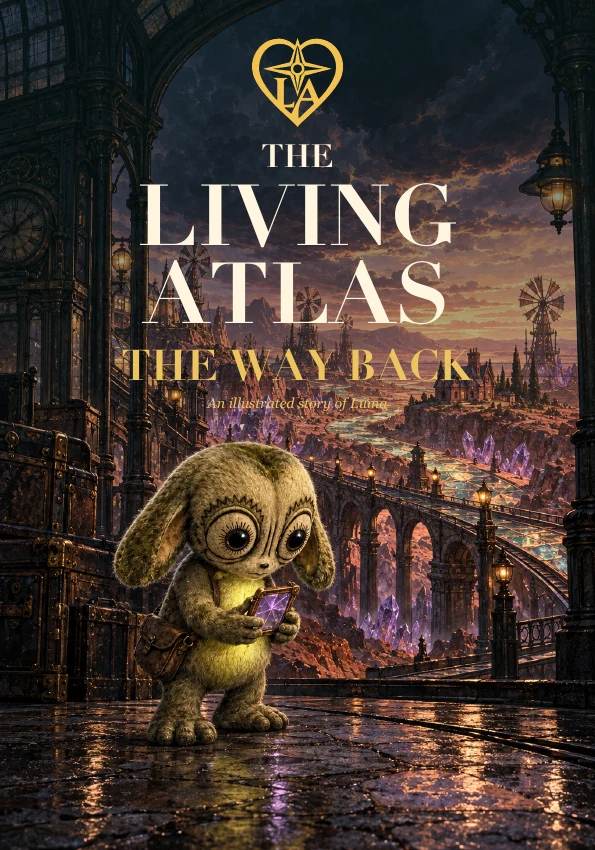
The Way Back illustrated book cover

THE STORY SHELF · ILLUSTRATED FICTION

The Way Back

A curious parcel. A house beyond reach. Luma leaves the station to follow a small piece of glass—and discovers how much a lost thing can be worth.

31 illustrated pages · 24 minutes of narrationREAD OR LISTEN TO THE STORY →
DESK NOTES45 INHABITANTS · 55 PLACES · 5 INCIDENTS

Mossbridge Terrace

Brackenvice

Brackenvice keeps the Ravelgreen’s living walkways passable.

Windtower Yard

Brackle

Brackle listens for mechanical faults in Glassweather’s windtowers.

Heatbrick Ward

Bram Sivet

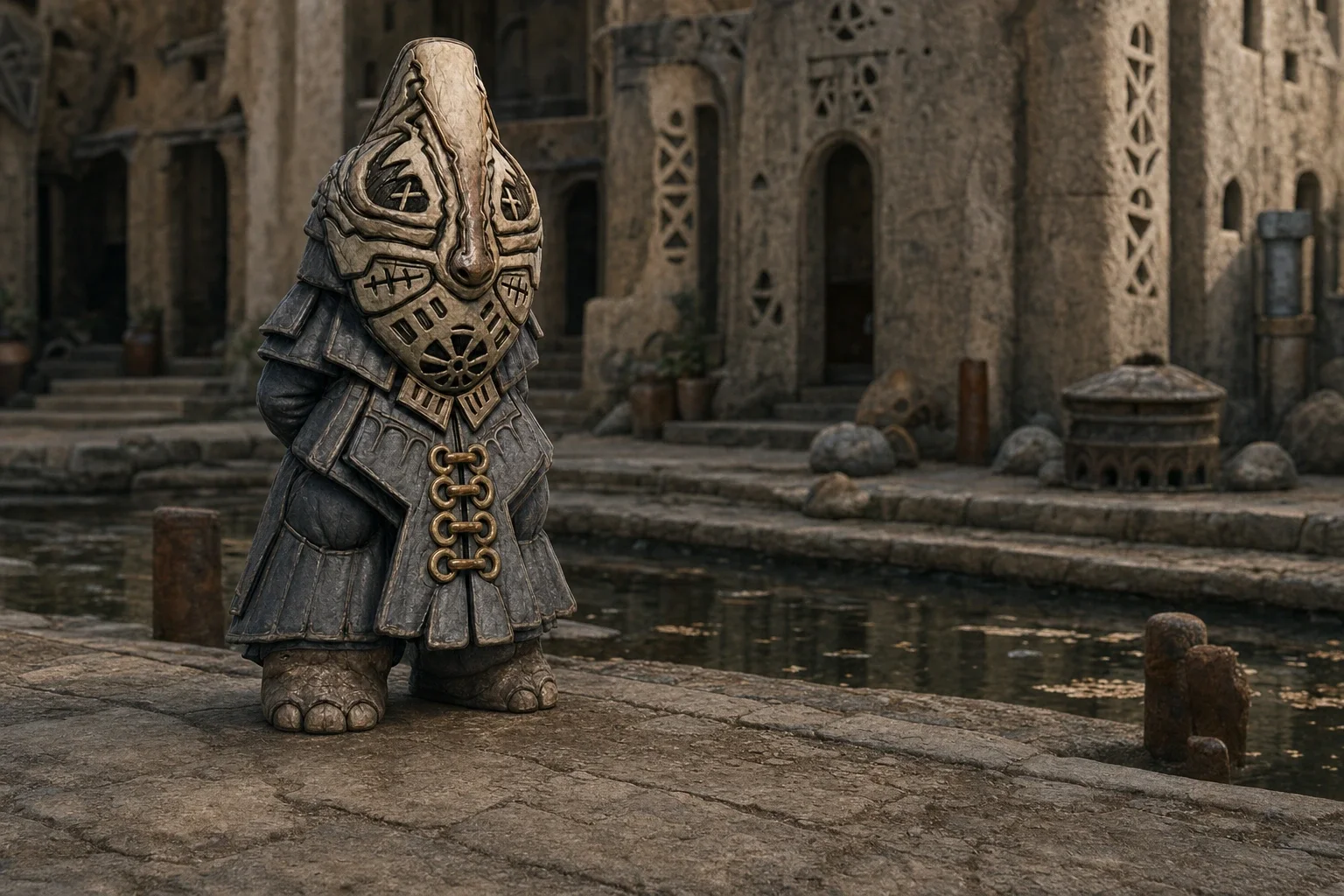
Bram Sivet inspects heat bricks for cracks and uneven warmth in Sunspindle Commons.

Platform Arcade

Brindle

Brindle carries orders between the vendors of Platform Arcade and minds counters when their owners step away.
PRINTED FROM GOVERNED WORLD RECORDS · INTERPRETATION IDENTIFIED · PRIVATE WORK EXCLUDEDRETURN TO THE SURVEY